taskTracker makes you book a demo to learn what it costs. TurfCaddie posts the number: $2,195 a year per facility, unlimited users, and it covers the spray records, chemical inventory, and water that are not on taskTracker's published feature list.
taskTracker is on roughly 1,000 courses for a reason. It was built by a superintendent out of the same whiteboard problem every shop knows: you write the morning lineup on the board, and by dark you erase all of that valuable information. The board works, crews know it, and it has a decade of trust behind it.
It also does things we will not claim. Its time clock costs labor down to the task, which is payroll-grade reporting. It tracks safety training for the crew. Its equipment side runs deep for technicians, parts inventory and barcode work orders included. If labor costing to the task is the whole of your decision, taskTracker is a strong product and you should weigh that honestly.
Here is what its current published feature list does not include: spray records, chemical inventory, and water tracking. So the board gets bought, and then the records problem gets bought separately, from somebody else. That stack, not the board by itself, is the real comparison.
This is the order these decisions get made in the shop, so this is the order we answer them in.
1. When the inspector walks in. He does not ask about your board. He asks for the application record: product and EPA registration number, rate, area treated, target pest, applicator, weather at application, REI, PPE, kept for two years and displayable where the crew can see it. TurfCaddie logs every application once and prints a one-page spray sheet with the full field set, active ingredient applied and nutrients computed from each product's guaranteed analysis. That record lives in the same system as tomorrow's board. taskTracker's published feature list has no spray record at all.
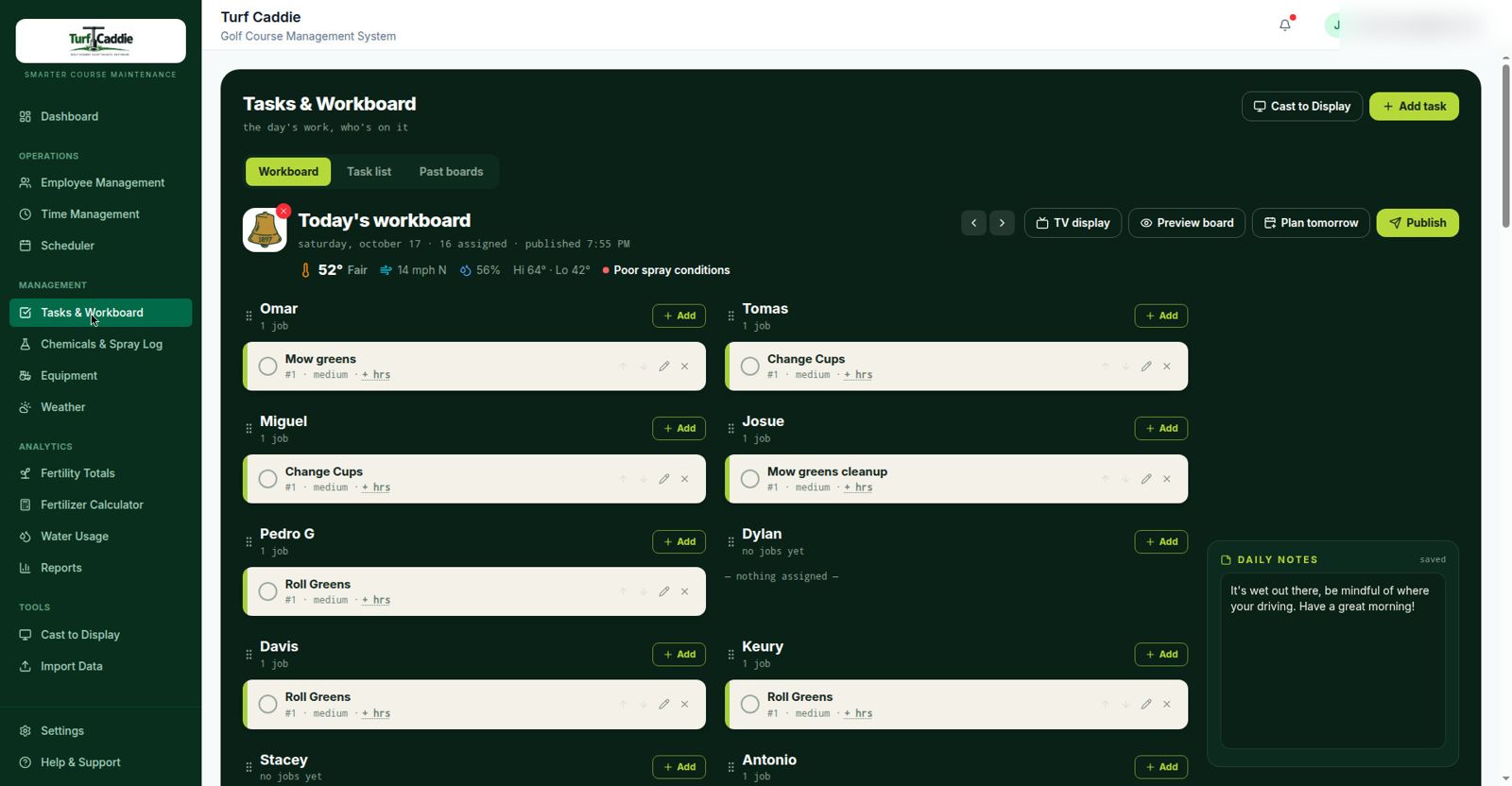
2. Whether the crew will use it. Your crew did not sign up to learn software. The board goes up on the shop TV, each man pulls his own jobs on his phone, and a mid-morning change posts without anyone walking back to a whiteboard that, by the end of the day, you cannot tell what was what on. At the founder's club in New Jersey, a 16-person crew runs on it every morning.
3. Logging it where it happened. A spray gets logged off the sprayer, in the field, not rebuilt at 6 PM from a notebook in your shirt pocket. Rate, weather, and totals are captured at entry, and the product comes out of inventory the moment the application is saved. One entry, and the record, the sheet, and the shelf count all agree.
4. The board on the TV. Table stakes, and taskTracker does it well. TurfCaddie casts the morning lineup to the shop TV in one tap, mow patterns and the day's notes on screen, readable from the back of the room. The difference is what hangs off the board: the screen your crew reads at 5 AM is fed by the same records, inventory, and water numbers the office side answers for.
5. Whose data it is. Your labor history, your spray records, your inventory. Export them when you want them. Leave, and they leave with you. The whiteboard got erased every day; that was the problem software was supposed to solve.
6. What it costs, in print. taskTracker publishes no price. Not on its product page, not anywhere we could find on its site. You learn it on a sales call. TurfCaddie is $2,195 a year per facility, unlimited users, printed on the pricing page where your greens committee can read it before anyone books a demo. Against the stack most shops actually run, a board plus a separate chemical records tool at $299 a year and up, plus whatever tracks fleet and water, one published number is the honest comparison.
7. Who answers. TurfCaddie was built by a working superintendent who still runs a course every morning. Support is email answered by people who know what an REI is and why a breakdown on a Saturday matters. The founder does your setup with you, not from a manual.
8. The report for the committee. Labor and application history roll into reports you can hand a greens committee or a GM: what got done, what it cost, what went down and where. The same records that satisfy the inspector make your budget case in the fall.
What each system covers, per published feature lists as of October 2026.
| What your shop runs on | taskTracker | TurfCaddie |
|---|---|---|
| Daily job board and shop TV | Yes, its core product | Yes |
| Spray records with the full WPS field set | Not on its published feature list | Yes, one-page printable sheets |
| Chemical inventory | Not on its published feature list | Yes, deducted automatically at application |
| Fleet and equipment | Yes, deep technician tooling, parts and barcodes | Yes, service intervals and QR decals |
| Time clock and labor costing | Yes, hours costed down to the task | Yes, time tracking and labor cost reporting |
| Water usage vs. allocation | Not on its published feature list | Yes, monthly and annual caps, plus rainfall |
| Weather and GDD | Yes, GDD, soil moisture via turfRad | Yes, GDD base 32 and 50, go/no-go spray verdicts |
| Multi-course portfolio view | Not on its published feature list | Yes, included free for operators |
| Pricing | Not published. Demo required | $2,195/yr per facility, unlimited users |
| Setup | Not published | $495 one time, founder-led, waived for Founding 50 |
Competitor details reflect taskTracker's published feature list and public pages as of October 2026. Where that list is silent, we say so rather than guess. Check theirs, then check ours.
There is no honest way to total taskTracker's price, because they do not publish one. What can be totaled is the records side the board leaves uncovered, at prices those vendors do publish.
| The pieces around the board | Per year |
|---|---|
| Board subscription (taskTracker) | Price not published |
| Chemical records on top of it (SPaRKS) | $299/yr |
| Or program planning instead (Playbooks Core) | $795/yr + $300 setup |
| Fleet and water tracking | Another tool, or a spreadsheet |
| TurfCaddie: board, records, inventory, fleet, water | $2,195/yr |
The questions superintendents actually ask before they switch.
Straight answer: nobody else sells the whole morning in one system, and that is how this category has always worked. taskTracker does the board, and its fleet tooling is genuinely deep. Spray records live in separate products like SPaRKS and Playbooks. Chemical inventory and water live in another tool, or in a spreadsheet. TurfCaddie is the one system: board, spray records, chemical inventory, fleet, and water under one login, for one bill. The choice is not really board versus board. It is one system versus a stack.
If price is no object, taskTracker is a fine board, no argument here. Most superintendents build a fall budget that has to survive a greens committee, and that is who published pricing is for. TurfCaddie's $2,195 a year per facility is printed on this site: unlimited users, and it covers the board plus the spray records, chemical inventory, and water that are not on taskTracker's published feature list. taskTracker's price you learn after booking a demo, and it buys the board.
The 5 AM relay race. The hardest part of the morning is not any single job. It is holding the whole day in your head: who is where, what the weather did to the plan overnight, and whether the spray that has to go out gets logged right. TurfCaddie puts assignments, mowing patterns, and daily notes on the shop TV before the crew walks in, changes post from your phone without a trip back to the whiteboard, and logging a spray writes the record and deducts the product in the same step. You run the course instead of relaying it.
In most shops, everywhere the stack stops: spray logs in a binder, inventory counted on a clipboard, fleet hours on a whiteboard, and the day's changes relayed by phone. Every one of those is a place a record can go missing. In TurfCaddie the binder becomes the printed spray sheet, the clipboard count deducts itself when a spray is logged, the whiteboard becomes the TV board, and a change made on your phone is on every screen in the shop. One system, one entry, nothing riding on a phone call.
That is the right first question, and it is why the board lives on the shop TV and on each man's phone instead of in an office. Assignments, mow patterns, and daily notes are on the screen at 5 AM, and changes you make from your phone post without a trip back to the whiteboard. It runs every morning at a private club in New Jersey with a 16-person crew, and the superintendent standing in front of that board is the man who built it.
You print the sheet. Every application is logged with product and EPA registration number, rate, area treated, target pest, applicator, weather at application, REI, and PPE. The sheet computes active ingredient applied and nutrients delivered from each product's guaranteed analysis, and the history stays searchable by date, product, or area. The records live in the same system as the board, the inventory, and the water, not in a separate tool or a binder.
Applications are open for the Founding 50 pilot. Thirty days, full platform, white-glove setup.
Apply for the Pilot